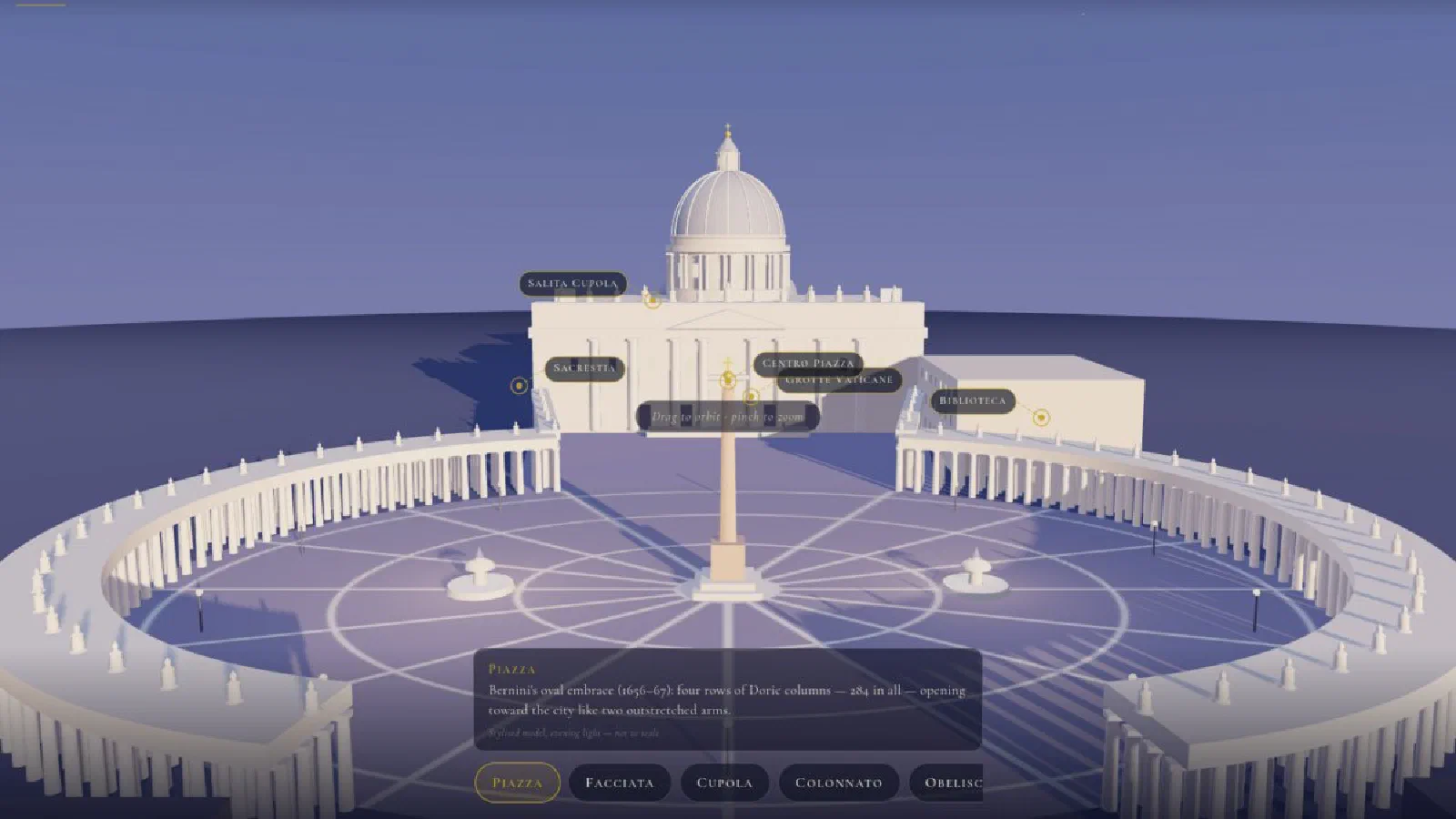
I spent an afternoon last week poking at Three.js, and the result were so surprising: two interactive 3D Roman landmarks — St. Peter’s Basilica and the Pantheon — built from a single lazy prompt to Fable 5.
What Three.js actually is
Three.js is a JavaScript library that puts real 3D graphics in the browser. Under the hood it’s a friendly wrapper over WebGL, the low-level API that talks to your GPU. WebGL on its own is famously painful — shaders, buffers, matrix math. Three.js hands you the nouns you actually think in: a scene, a camera, lights, meshes, materials. You describe what’s in the world, it does the drawing, every frame, on the graphics card.
No plugin, no install. It’s just a webpage. Anyone with a link can orbit the model on their phone.
If you want to see how far this can be pushed, look at Bruno Simon’s portfolio. His site is a fully drivable 3D car game, and he teaches the craft through Three.js Journey. That’s the ceiling. What follows is me on day one.
What it’s good for
- Product and architecture viewers — let people rotate a thing instead of scrolling through ten photos of it.
- Data and maps in 3D — terrain, networks, anything that reads better with depth.
- Interactive scenes for the web — landing pages, games, explorable places.
- Quick spatial prototypes — block out a building or a layout before anyone models it “for real.”
That last one is exactly what I was testing.
The experiment: one prompt, two buildings
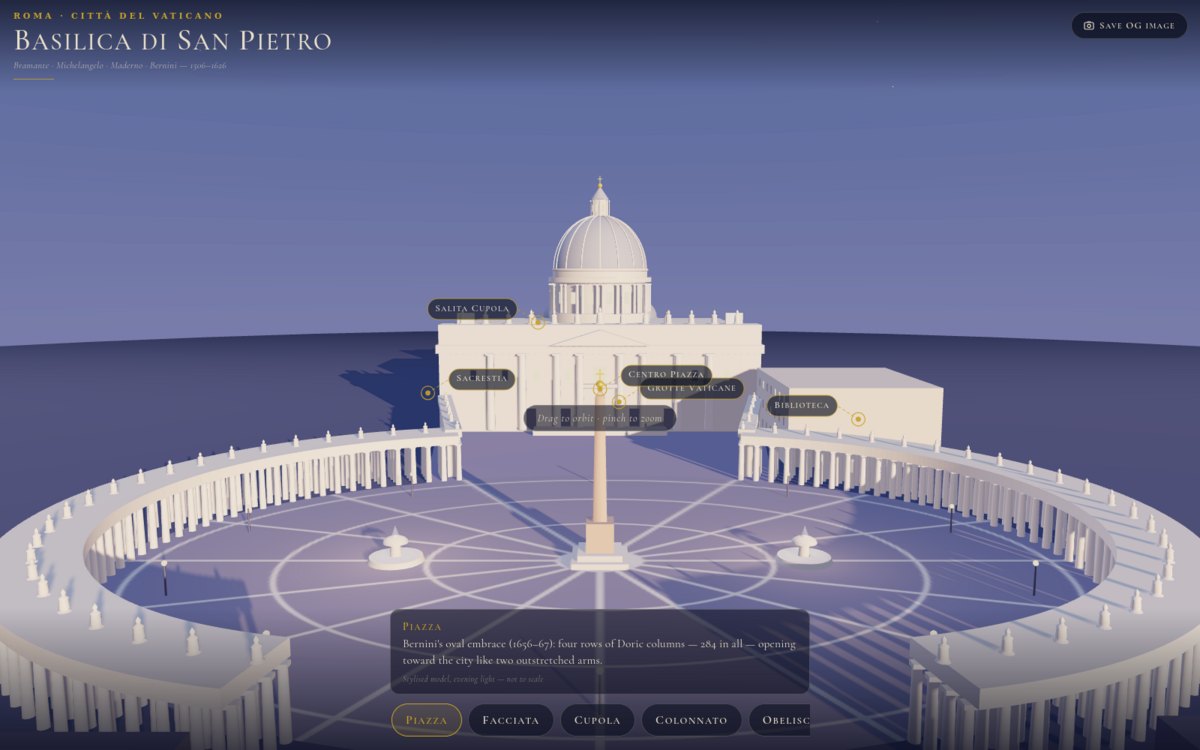
I gave Fable 5 a single prompt and asked for interactive Three.js scenes of two Roman landmarks for Rome With Bert. What came back wasn’t a screenshot or a rough sketch — it was working code: full Three.js scenes I could open in a browser and move around in.
- The Basilica di San Pietro at dusk — the dome, the colonnade sweeping out front, the obelisk, soft warm light against a navy sky, with points of interest you can find by orbiting: the Vatican Library, the Grottoes, the climb up the cupola. Orbit the live scene →
- The Pantheon — that impossible dome and its oculus, the portico columns, the whole geometry you can circle. Orbit the live scene →
Both real, both interactive, both from the same prompt.
What I took away
What struck me wasn’t that the geometry was perfect — it isn’t, and it doesn’t need to be. It’s that the distance from idea to a thing-you-can-touch collapsed. A few minutes earlier these were two sentences; now they were scenes you could orbit on a phone. For a travel brand and a passionate about tech like me, I thought is was a great to show a place and maybe add some “hyper-local” suggestion or tips for places in Rome, than Google Maps might not give right away.
I’ll be folding these into Rome With Bert with better content. But the real takeaway is smaller and more useful: **Three.js makes 3D on the web approachable, and a good model makes the first draft of it nearly free.