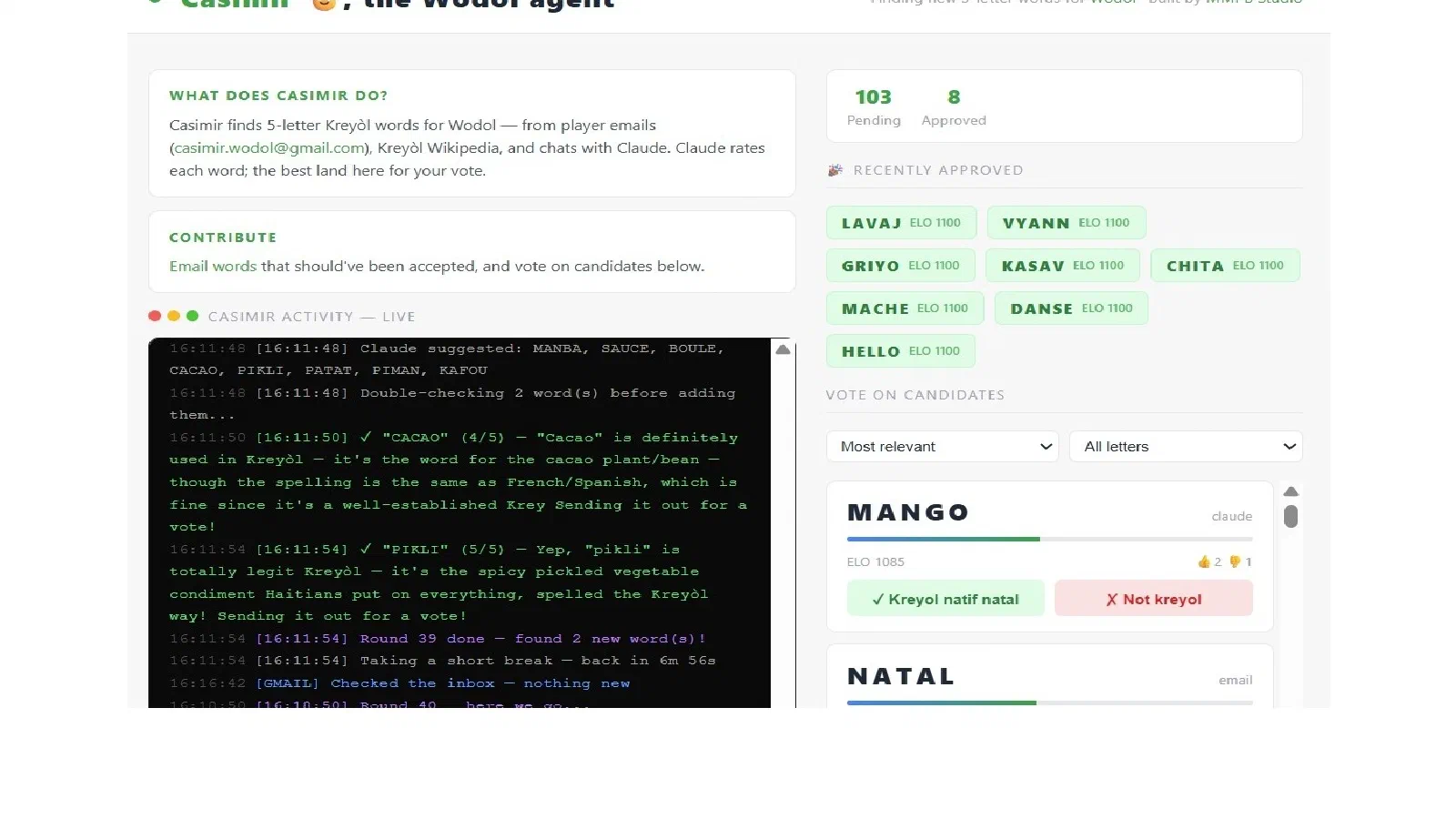
Behind Wodol, my 5-letter Haitian Creole word game, there’s an autonomous agent named Casimir. His job sounds simple — find new Kreyòl words for the game — but doing it well means not trusting a language model’s word for it.
Yesterday I made a bet on web search, it blew through the budget, and I spent the afternoon unwinding it. This is the version that tells that story straight — because the back-and-forth is the engineering lesson.
Casimir is built on Claude Sonnet 4.6, runs as a long-lived service, and works in continuous rounds: discover → filter → screen → verify → vote.
The bet: ground the model in the real web
A language model will happily invent a plausible-looking “Kreyòl” word that no Haitian has ever said. That was Casimir’s biggest quality problem — confident and sometimes wrong.
So I reached for the obvious fix: stop trusting the model and check the
world. I gave him the native web_search tool in two places — discovery
(read real Kreyòl on the live web and harvest words people actually use) and
per-word verification (confirm a borderline candidate is real before it goes
to a vote). It worked. Word quality jumped immediately, and it was fun to watch
him narrate each search on the live feed: "🌐 Heading out to read real Kreyòl
on the web…" then "🔎 Web search backs SOUKE up." I was pleased with
myself.
The bill: web search was eating the whole budget
Wodol runs on a deliberately hard budget: under $10 a month of API spend — that’s the whole game’s allowance. And web search is the single most expensive thing Casimir does, in two ways that compound: a per-search fee for every query, plus the page snippets it pulls back, billed as input tokens.
I’d put it on the hot path — potentially every round for discovery, and on every borderline word for verification — at a cadence of a new round every 4–8 minutes. That math doesn’t fit in $10/month; it doesn’t fit in several times that. The thing that made the words better was quietly going to make the project unaffordable.
The walk-back: gate it, then slash it
I fixed it in two passes. First, gate the obvious waste: stop paying twice to verify a word that was already harvested from real web text, fire verification only on genuinely borderline pre-screen scores, and add a hard per-day search cap as a runaway backstop that degrades gracefully to the pre-screen once spent.
Then, slash it to the bone:
- Per-word verification is now OFF by default. The Sonnet pre-screen score stands on its own; the steady, every-round path touches web search zero times. (One env var flips it back on for a borderline word.)
- Open-web discovery dropped from ~1-round-in-5 to about once a week, gated by a timestamp persisted in memory.
- The daily search safety cap came down from 200 to 12.
- Round cadence slowed from ~4–8 min to ~25–35 min, so even the cheap, steady brainstorm/pre-screen spend comfortably fits the budget.
Every threshold is an environment variable, so the whole cost/quality dial moves without a code change.
The status now
The steady state today: brainstorm + a cheap pre-screen every round, no web search on the routine path, one open-web dig roughly weekly as a treat, and a hard daily cap as a backstop. Estimated spend is ~$6–8/month — back inside the $10 line, with a once-a-day "💰 API spend: ~$X.XX" line posted to the feed so the number stays in view.
But “estimated” is the honest word. I deployed this yesterday and am watching the real numbers over a few days. If spend still runs hot, the next lever is already identified: slow the cadence further (toward hourly), which models out to roughly $3–5/month.
The rest of the machine
Most of Casimir never needed touching:
🧠 Brainstorming — the default every round. He asks Claude for authentic everyday words across 8 themed angles, injecting recent player verdicts so suggestions self-correct. The angles aren’t random: a one-function Thompson-sampling bandit explores angles that produce keepers and lets duds fade — tuning Casimir to the community’s taste with no manual prompt-tweaking.
📨 Reader submissions — a Gmail mailbox lets anyone email a suggestion, which runs the identical gate (spam-filtered, rate-limited).
The quality gate — free format check (5 letters, plain
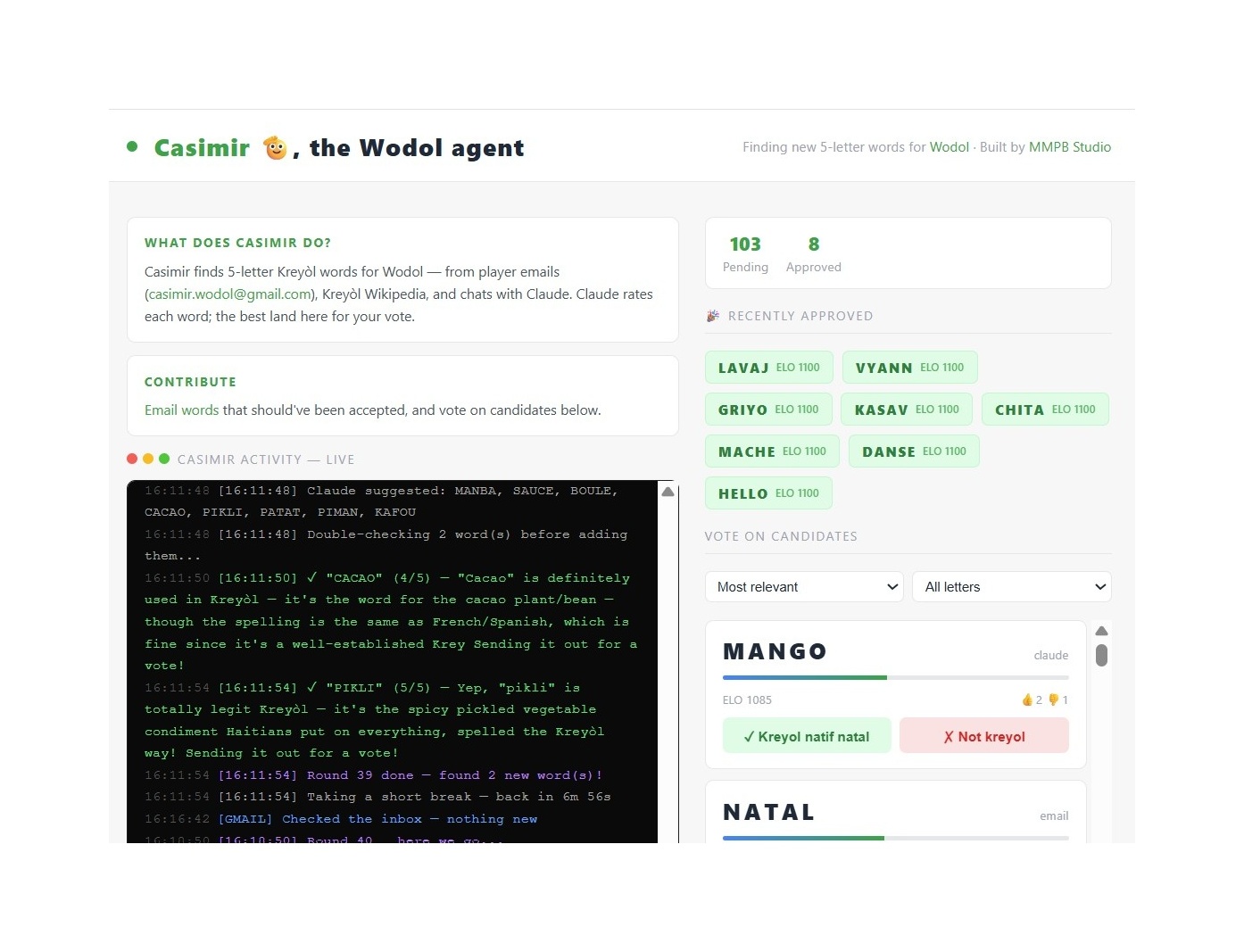
a–z) and duplicate check, then a cheap pre-screen: a 1–5 confidence read from Claude, tuned not to penalize legitimate cognates like legim or recho. That call now decides a word’s fate on its own; online verification is the opt-in step that started all this.The vote — Casimir proposes; players dispose. Every survivor goes to a public vote settled by an ELO rating (start 1000, 👍 +50, 👎 −15). A word is promoted at ELO ≥ 1100 with ≥ 2 voters, auto-rejected at ≤ 800 with ≥ 3 — the voter minimums stop any single voter from pushing a word in or burying it.
He thinks out loud — Casimir narrates everything to a live terminal feed, every word weighed and every verdict. That narration is what made the web-search cost visible in the first place.
What I actually learned
- Ground the model, don’t trust it. Verifying words against real usage was the biggest quality win. The instinct was right — it just wasn’t free.
- Price the fix before you ship it. I put web search on the hot path before I could see what it cost; the rest of the day was spent correcting that.
- Match the spend to the stakes. A word game doesn’t need a search on every candidate. Free filters and a cheap pre-screen do the routine work for fractions of a cent; the expensive search is rationed to a weekly treat.
- Make the dial turn without a redeploy. Every threshold is an env var, so walking the cost up or down is a config change, not a project.
Casimir isn’t trying to be clever — he’s trying to be right, to stay inside a small budget, and to leave the final word to Haitian Creole speakers themselves. Grenadye alaso! 🇭🇹